

How To Apply A Wingetts Template For Grandpa
| Sir Arthur Conan Doyle KStJ DL | |
|---|---|
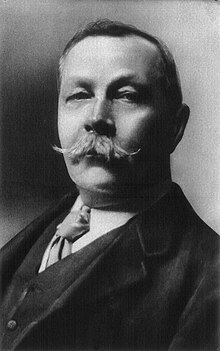 Arthur Conan Doyle in June 1914 | |
| Born | Arthur Ignatius Conan Doyle (1859-05-22)22 May 1859 Edinburgh, Midlothian, Scotland |
| Died | 7 July 1930(1930-07-07) (aged 71) Crowborough, Sussex, England |
| Occupation |
|
| Education | Academy of Edinburgh |
| Genre |
|
| Notable works |
|
| Spouse |
|
| Children | v (including Adrian and Jean) |
| Signature |  |
| Website | |
| world wide web | |
Sir Arthur Ignatius Conan Doyle KStJ DL (22 May 1859 – 7 July 1930) was a British author and md. He created the graphic symbol Sherlock Holmes in 1887 for A Study in Reddish, the offset of four novels and fifty-six curt stories about Holmes and Dr. Watson. The Sherlock Holmes stories are milestones in the field of crime fiction.
Doyle was a prolific writer; other than Holmes stories, his works include fantasy and science fiction stories almost Professor Challenger and humorous stories well-nigh the Napoleonic soldier Brigadier Gerard, as well every bit plays, romances, verse, non-fiction, and historical novels. One of Doyle'southward early short stories, "J. Habakuk Jephson's Argument" (1884), helped to popularise the mystery of the Mary Celeste.
Name [edit]
Doyle is often referred to equally "Sir Arthur Conan Doyle" or "Conan Doyle", implying that "Conan" is part of a compound surname rather than a centre proper noun. His baptism entry in the register of St Mary'south Cathedral, Edinburgh, gives "Arthur Ignatius Conan" as his given names and "Doyle" every bit his surname. It as well names Michael Conan as his godfather.[i] The catalogues of the British Library and the Library of Congress treat "Doyle" alone equally his surname.[2]
Steven Doyle, publisher of The Baker Street Journal, wrote: "Conan was Arthur's middle name. Shortly after he graduated from loftier school he began using Conan as a sort of surname. Merely technically his last name is simply 'Doyle'."[iii] When knighted, he was gazetted as Doyle, not nether the chemical compound Conan Doyle.[iv]
Early life [edit]

Doyle was born on 22 May 1859 at xi Picardy Identify, Edinburgh, Scotland.[5] [half dozen] His male parent, Charles Altamont Doyle, was built-in in England, of Irish gaelic Catholic descent, and his mother, Mary (née Foley), was Irish Catholic. His parents married in 1855.[7] In 1864 the family scattered considering of Charles'southward growing alcoholism, and the children were temporarily housed beyond Edinburgh. Arthur lodged with Mary Burton, the aunt of a friend, at Liberton Depository financial institution Firm on Gilmerton Road, while studying at Newington Academy.[8]
In 1867, the family came together again and lived in squalid tenement flats at three Sciennes Place.[9] Doyle's male parent died in 1893, in the Crichton Royal, Dumfries, after many years of psychiatric illness.[x] [11] Showtime at an early age, throughout his life Doyle wrote letters to his mother, and many of them were preserved.[12]
Supported by wealthy uncles, Doyle was sent to England, to the Jesuit preparatory school Hodder Place, Stonyhurst in Lancashire, at the age of nine (1868–lxx). He and then went on to Stonyhurst College, which he attended until 1875. While Doyle was not unhappy at Stonyhurst, he said he did not take whatever fond memories of it because the schoolhouse was run on medieval principles: the only subjects covered were rudiments, rhetoric, Euclidean geometry, algebra and the classics.[13] Doyle commented after in his life that this academic arrangement could only exist excused "on the plea that whatsoever practice, however stupid in itself, forms a sort of mental dumbbell past which one tin improve one's heed."[thirteen] He also establish the school harsh, noting that, instead of compassion and warmth, it favoured the threat of corporal penalization and ritual humiliation.[14]
From 1875 to 1876, he was educated at the Jesuit school Stella Matutina in Feldkirch, Republic of austria.[9] His family decided that he would spend a year there in order to perfect his German language and broaden his academic horizons.[15] He later rejected the Cosmic faith and became an doubter.[16] One source attributed his drift away from organized religion to the time he spent in the less strict Austrian school.[14] He also later became a spiritualist mystic.[17]
Medical career [edit]
From 1876 to 1881, Doyle studied medicine at the University of Edinburgh Medical Schoolhouse; during this period he spent fourth dimension working in Aston (then a town in Warwickshire, now part of Birmingham), Sheffield and Ruyton-XI-Towns, Shropshire.[18] Also during this period, he studied practical botany at the Royal Botanic Garden in Edinburgh.[xix] While studying, Doyle began writing short stories. His earliest extant fiction, "The Haunted Grange of Goresthorpe", was unsuccessfully submitted to Blackwood's Magazine.[nine] His offset published piece, "The Mystery of Sasassa Valley", a story prepare in S Africa, was printed in Chambers's Edinburgh Journal on 6 September 1879.[9] [xx] On 20 September 1879, he published his kickoff academic article, "Gelsemium as a Poison" in the British Medical Journal,[9] [21] [22] a study which The Daily Telegraph regarded equally potentially useful in a 21st-century murder investigation.[23]
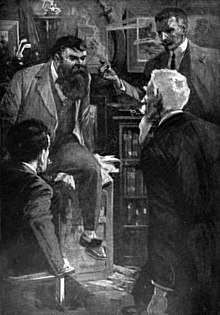
Doyle was the doctor on the Greenland whaler Hope of Peterhead in 1880.[24] On 11 July 1880, John Greyness's Hope and David Grey's Eclipse met up with the Eira and Leigh Smith. The lensman W. J. A. Grant took a photo aboard the Eira of Doyle along with Smith, the Gray brothers, and ship'due south surgeon William Neale, who were members of the Smith expedition. That trek explored Franz Josef Land, and led to the naming, on 18 Baronial, of Cape Flora, Bell Island, Nightingale Sound, Gratton ("Uncle Joe") Isle, and Mabel Island.[25]
Afterward graduating with Bachelor of Medicine and Master of Surgery (Thousand.B. C.Grand.) degrees from the University of Edinburgh in 1881, he was ship's surgeon on the SS Mayumba during a voyage to the West African declension.[nine] He completed his Doctor of Medicine (M.D.) degree (an avant-garde degree beyond the basic medical qualification in the UK) with a dissertation on tabes dorsalis in 1885.[26]
In 1882, Doyle partnered with his one-time classmate George Turnavine Budd in a medical do in Plymouth, but their relationship proved difficult, and Doyle presently left to gear up up an independent practise.[9] [27] Arriving in Portsmouth in June 1882, with less than £ten (£1100 in 2019[28]) to his proper name, he ready up a medical practice at 1 Bush Villas in Elm Grove, Southsea.[29] The practise was not successful. While waiting for patients, Doyle returned to writing fiction.
Doyle was a staunch supporter of compulsory vaccination and wrote several manufactures advocating the do and denouncing the views of anti-vaccinators.[30] [31]
In early on 1891, Doyle embarked on the study of ophthalmology in Vienna. He had previously studied at the Portsmouth Eye Infirmary in order to qualify to perform middle tests and prescribe glasses. Vienna had been suggested by his friend Vernon Morris as a place to spend six months and train to exist an heart surgeon. But Doyle found it too difficult to sympathize the German medical terms being used in his classes in Vienna, and soon quit his studies there. For the residuum of his ii-month stay in Vienna, he pursued other activities, such as ice skating with his married woman Louisa and drinking with Brinsley Richards of the London Times. He also wrote The Doings of Raffles Haw.
After visiting Venice and Milan, he spent a few days in Paris observing Edmund Landolt, an skillful on diseases of the center. Inside three months of his divergence for Vienna, Doyle returned to London. He opened a minor function and consulting room at 2 Upper Wimpole Street, or ii Devonshire Identify as information technology was then. (There is today a Westminster City Council commemorative plaque over the forepart door.) He had no patients, according to his autobiography, and his efforts equally an ophthalmologist were a failure.[32] [33] [34]
Literary career [edit]
Sherlock Holmes [edit]

Doyle struggled to observe a publisher. His first work featuring Sherlock Holmes and Dr. Watson, A Study in Scarlet, was written in three weeks when he was 27 and was accustomed for publication past Ward Lock & Co on twenty Nov 1886, which gave Doyle £25 (equivalent to £ii,900 in 2019) in exchange for all rights to the story. The slice appeared a year later in the Beeton'southward Christmas Almanac and received practiced reviews in The Scotsman and the Glasgow Herald.[9]
Holmes was partially modelled on Doyle'due south former academy instructor Joseph Bell. In 1892, in a letter of the alphabet to Bell, Doyle wrote, "Information technology is almost certainly to you that I owe Sherlock Holmes ... circular the center of deduction and inference and observation which I have heard you inculcate I have tried to build up a man",[35] and in his 1924 autobiography, he remarked, "It is no wonder that after the study of such a graphic symbol [viz., Bell] I used and amplified his methods when in later life I tried to build upward a scientific detective who solved cases on his own merits and not through the folly of the criminal."[36] Robert Louis Stevenson was able to recognise the potent similarity between Joseph Bell and Sherlock Holmes: "My compliments on your very ingenious and very interesting adventures of Sherlock Holmes. ... tin this exist my old friend Joe Bell?"[37] Other authors sometimes suggest additional influences—for example, Edgar Allan Poe's character C. Auguste Dupin, who is mentioned, disparagingly, by Holmes in A Study in Scarlet.[38] Dr. (John) Watson owes his surname, merely not any other obvious characteristic, to a Portsmouth medical colleague of Doyle's, Dr. James Watson.[39]

Sherlock Holmes statue in Edinburgh, erected reverse the birthplace of Doyle, which was demolished c. 1970
A sequel to A Study in Scarlet was deputed, and The Sign of the Four appeared in Lippincott'due south Mag in February 1890, under agreement with the Ward Lock visitor. Doyle felt grievously exploited by Ward Lock as an author new to the publishing earth, so, after this, he left them.[9] Brusk stories featuring Sherlock Holmes were published in the Strand Mag. Doyle wrote the starting time five Holmes brusk stories from his office at 2 Upper Wimpole Street (then known as Devonshire Place), which is now marked past a memorial plaque.[forty]
Doyle's attitude towards his most famous creation was clashing.[39] In November 1891, he wrote to his mother: "I think of slaying Holmes, ... and winding him upward for adept and all. He takes my heed from better things." His mother responded, "You won't! You tin't! Yous mustn't!"[41] In an attempt to deflect publishers' demands for more Holmes stories, he raised his price to a level intended to discourage them, but institute they were willing to pay even the large sums he asked.[39] Every bit a result, he became one of the best-paid authors of his time.

Statue of Holmes and the English language Church in Meiringen
In Dec 1893, to dedicate more of his time to his historical novels, Doyle had Holmes and Professor Moriarty plunge to their deaths together downwardly the Reichenbach Falls in the story "The Concluding Problem". Public outcry, however, led him to feature Holmes in 1901 in the novel The Hound of the Baskervilles. Holmes's fictional connexion with the Reichenbach Falls is historic in the nearby town of Meiringen.
In 1903, Doyle published his first Holmes short story in ten years, "The Gamble of the Empty House", in which it was explained that only Moriarty had fallen, but since Holmes had other dangerous enemies—especially Colonel Sebastian Moran—he had arranged to brand information technology expect equally if he as well were dead. Holmes was ultimately featured in a total of 56 short stories—the last published in 1927—and four novels by Doyle, and has since appeared in many novels and stories by other authors.
Other works [edit]

Doyle's start novels were The Mystery of Cloomber, not published until 1888, and the unfinished Narrative of John Smith, published only posthumously, in 2011.[42] He amassed a portfolio of curt stories, including "The Captain of the Pole-Star" and "J. Habakuk Jephson'due south Statement", both inspired by Doyle's time at sea. The latter popularised the mystery of the Mary Celeste [43] and added fictional details such as that the ship was found in perfect condition (it had actually taken on water past the time it was discovered), and that its boats remained on board (the single boat was in fact missing). These fictional details have come up to dominate pop accounts of the incident,[9] [43] and Doyle's alternate spelling of the ship's name every bit the Marie Celeste has get more commonly used than the original spelling.[44]
Betwixt 1888 and 1906, Doyle wrote 7 historical novels, which he and many critics regarded every bit his best work.[39] He besides wrote 9 other novels, and—after in his career (1912–29)—five narratives (two of novel length) featuring the irascible scientist Professor Challenger. The Challenger stories include his best-known work after the Holmes oeuvre, The Lost World. His historical novels include The White Company and its prequel Sir Nigel, set up in the Heart Ages. He was a prolific writer of curt stories, including two collections set up in Napoleonic times and featuring the French grapheme Brigadier Gerard.
Doyle's works for the stage include: Waterloo, which centres on the reminiscences of an English veteran of the Napoleonic Wars and features a grapheme Gregory Brewster, written for Henry Irving; The House of Temperley, the plot of which reflects his constant interest in boxing; The Speckled Ring, adjusted from his earlier short story "The Gamble of the Speckled Band"; and an 1893 collaboration with J. G. Barrie on the libretto of Jane Annie.[45]
Sporting career [edit]
While living in Southsea, the seaside resort of Portsmouth, Doyle played football game as a goalkeeper for Portsmouth Association Football Social club, an apprentice side, nether the pseudonym A. C. Smith.[46]
Doyle was a keen cricketer, and between 1899 and 1907 he played 10 start-class matches for the Marylebone Cricket Club (MCC).[47] He besides played for the apprentice cricket teams the Allahakbarries and the Authors Xi alongside fellow writers J. M. Barrie, P. Chiliad. Wodehouse and A. A. Milne.[48] [49] His highest score, in 1902 against London County, was 43. He was an occasional bowler who took one first-class wicket, Westward. M. Grace, and wrote a poem almost the accomplishment.[l]
In 1901, Doyle was one of three judges for the world's first major bodybuilding competition, which was organised past the "Father of Bodybuilding", Eugen Sandow. The event was held in London's Royal Albert Hall. The other two judges were the sculptor Sir Charles Lawes-Wittewronge and Eugen Sandow himself.[51]
Doyle was an amateur boxer.[52] In 1909, he was invited to referee the James Jeffries–Jack Johnson heavyweight title fight in Reno, Nevada. Doyle wrote: "I was much inclined to take ... though my friends pictured me as winding up with a revolver at one ear and a razor at the other. Still, the distance and my engagements presented a final bar."[52]
Likewise a keen golfer, Doyle was elected helm of the Crowborough Beacon Golf Club in Sussex for 1910. He had moved to Little Windlesham house in Crowborough with Jean Leckie, his second wife, and resided at that place with his family from 1907 until his death in July 1930.[53]
He entered the English Amateur billiards championship in 1913.[54]
While living in Switzerland, Doyle became interested in skiing, which was relatively unknown in Switzerland at the fourth dimension. He wrote an article, "An Alpine Pass on 'Ski'" for the December 1894 upshot of The Strand Mag,[55] in which he described his experiences with skiing and the beautiful alpine scenery that could be seen in the procedure. The article popularised the action and began the long association betwixt Switzerland and skiing.[56]
Family unit life [edit]
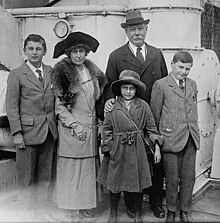
Doyle with his family c. 1923–1925

In 1885 Doyle married Louisa (sometimes called "Touie") Hawkins (1857–1906). She was the youngest daughter of J. Hawkins, of Minsterworth, Gloucestershire, and the sister of one of Doyle'southward patients. Louisa suffered from tuberculosis.[57] In 1907, the year later Louisa's death, he married Jean Elizabeth Leckie (1874–1940). He had met and fallen in dearest with Jean in 1897, but had maintained a platonic human relationship with her while his first married woman was still alive, out of loyalty to her.[58] Jean outlived him by ten years, and died in London.[59]
Doyle fathered five children. He had 2 with his get-go married woman: Mary Louise (1889–1976) and Arthur Alleyne Kingsley, known equally Kingsley (1892–1918). He had an additional three with his second married woman: Denis Percy Stewart (1909–1955), who became the 2d husband of Georgian Princess Nina Mdivani; Adrian Malcolm (1910–1970); and Jean Lena Annette (1912–1997).[60] None of Doyle's five children had children of their own, so he has no living direct descendants.[61] [62]
Political campaigning [edit]
Doyle served as a volunteer dr. in the Langman Field Infirmary at Bloemfontein between March and June 1900,[63] during the 2d Boer War in Due south Africa (1899–1902). Subsequently that twelvemonth, he wrote a book on the war, The Great Boer War, likewise equally a short piece of work titled The War in South Africa: Its Cause and Carry, in which he responded to critics of the United Kingdom'south role in that state of war, and argued that its function was justified. The latter work was widely translated, and Doyle believed information technology was the reason he was knighted (given the rank of Knight Bachelor) past King Edward VII in the 1902 Coronation Honours.[64] (He received the accolade from the Male monarch in person at Buckingham Palace on 24 October of that year.)[65]
He stood for Parliament twice as a Liberal Unionist: in 1900 in Edinburgh Primal; and in 1906 in the Hawick Burghs. He received a respectable share of the vote, but was not elected.[66] He served as a Deputy-Lieutenant of Surrey beginning in 1902,[67] and was appointed a Knight of Grace of the Order of the Hospital of Saint John of Jerusalem in 1903.[68]
Doyle was a supporter of the campaign for the reform of the Congo Free Land that was led by the announcer E. D. Morel and diplomat Roger Casement. In 1909 he wrote The Crime of the Congo, a long pamphlet in which he denounced the horrors of that colony. He became acquainted with Morel and Casement, and information technology is possible that, together with Bertram Fletcher Robinson, they inspired several characters that announced in his 1912 novel The Lost Globe.[69] Later, later on the Easter Rise, Casement was found guilty of treason against the Crown, and was sentenced to death. Doyle tried, unsuccessfully, to save him, arguing that Casement had been driven mad, and therefore should not exist held responsible for his actions.[70]
Equally the First World War loomed, and having been caught upwards in a growing public swell of Germanophobia, Doyle gave a public donation of x shillings to the anti-immigration British Brothers' League.[71]
Justice advocate [edit]
Doyle was also a fervent abet of justice and personally investigated ii airtight cases, which led to ii men beingness exonerated of the crimes of which they were defendant. The start case, in 1906, involved a shy half-British, half-Indian lawyer named George Edalji, who had allegedly penned threatening letters and mutilated animals in Groovy Wyrley. Police force were set on Edalji'southward conviction, even though the mutilations connected after their doubtable was jailed.[72] Apart from helping George Edalji, Doyle'south work helped establish a style to right other miscarriages of justice, as it was partially as a result of this case that the Court of Criminal Appeal was established in 1907.[73]
The story of Doyle and Edalji was dramatised in an episode of the 1972 BBC television series, The Edwardians. In Nicholas Meyer's pastiche The Westward End Horror (1976), Holmes manages to assist clear the name of a shy Parsi Indian grapheme wronged by the English justice system. Edalji was of Parsi heritage on his father'due south side. The story was fictionalised in Julian Barnes's 2005 novel Arthur and George, which was adapted into a three-role drama by ITV in 2015.
The 2nd case, that of Oscar Slater—a Jew of German origin who operated a gambling den and was convicted of bludgeoning an 82-year-sometime woman in Glasgow in 1908—excited Doyle's marvel because of inconsistencies in the prosecution's case and a general sense that Slater was not guilty. He ended upwardly paying most of the costs for Slater'due south successful 1928 appeal.[74]
Freemasonry and spiritualism [edit]
Doyle had a longstanding interest in mystical subjects and remained fascinated past the idea of paranormal phenomena, fifty-fifty though the strength of his belief in their reality waxed and waned periodically over the years.
In 1887, in Southsea, influenced by Major-General Alfred Wilks Drayson, a member of the Portsmouth Literary and Philosophical Society, Doyle began a series of investigations into the possibility of psychic phenomena and attended virtually 20 seances, experiments in telepathy, and sittings with mediums. Writing to spiritualist periodical Calorie-free that year, he alleged himself to exist a spiritualist, describing 1 particular event that had convinced him psychic phenomena were real.[75] Also in 1887 (on 26 January), he was initiated as a Freemason at the Phoenix Order No. 257 in Southsea. (He resigned from the Lodge in 1889, returned to it in 1902, and resigned once more in 1911.)[76]
In 1889, he became a founding member of the Hampshire Society for Psychical Research; in 1893, he joined the London-based Lodge for Psychical Research; and in 1894, he collaborated with Sir Sidney Scott and Frank Podmore in a search for poltergeists in Devon.[77]
Doyle and the spiritualist William Thomas Stead (before the latter was lost in the sinking of the Titanic) were led to believe that Julius and Agnes Zancig had 18-carat psychic powers, and they claimed publicly that the Zancigs used telepathy. However, in 1924, the Zancigs confessed that their mind reading act had been a fob; they published the secret code and all other details of the flim-flam method they had used nether the championship "Our Secrets!!" in a London newspaper.[78] Doyle also praised the psychic phenomena and spirit materialisations that he believed had been produced by Eusapia Palladino and Mina Crandon, both of whom were likewise subsequently exposed every bit frauds.[79]
In 1916, at the height of the Beginning Earth War, Doyle'due south belief in psychic phenomena was strengthened by what he took to be the psychic abilities of his children'due south nanny, Lily Loder Symonds.[80] This and the constant drumbeat of wartime deaths inspired him with the idea that spiritualism was what he called a "New Revelation"[81] sent past God to bring solace to the bereaved. He wrote a piece in Light magazine near his faith and began lecturing oftentimes on spiritualism. In 1918, he published his first spiritualist work, The New Revelation.
Some have mistakenly assumed that Doyle'south plough to spiritualism was prompted past the death of his son Kingsley, but Doyle began presenting himself publicly every bit a spiritualist in 1916, and Kingsley died on 28 October 1918 (from pneumonia contracted during his convalescence after being seriously wounded in the 1916 Battle of the Somme).[81] Nevertheless, the war-related deaths of many people who were close to him appears to have even further strengthened his long-held belief in life subsequently death and spirit communication. Doyle's blood brother Brigadier-general Innes Doyle died, likewise from pneumonia, in February 1919. His 2 brothers-in-law (one of whom was E. W. Hornung, creator of the literary graphic symbol Raffles), too every bit his two nephews, also died shortly later on the war. His second volume on spiritualism, The Vital Message, appeared in 1919.
Doyle found solace in supporting spiritualism'due south ideas and the attempts of spiritualists to find proof of an existence beyond the grave. In particular, according to some,[82] he favoured Christian Spiritualism and encouraged the Spiritualists' National Marriage to have an eighth precept – that of following the teachings and example of Jesus of Nazareth. He was a member of the renowned supernaturalist organisation The Ghost Gild.[83]

Doyle with his family in New York Metropolis, 1922
In 1919, the magician P. T. Selbit staged a séance at his flat in Bloomsbury, which Doyle attended. Although some afterward claimed that Doyle had endorsed the credible instances of clairvoyance at that séance every bit genuine,[84] [85] a contemporaneous report by the Sunday Limited quoted Doyle as saying "I should take to see it once more earlier passing a definite stance on it" and "I have my doubts about the whole thing".[86] In 1920, Doyle and the noted sceptic Joseph McCabe held a public debate at Queen's Hall in London, with Doyle taking the position that the claims of spiritualism were truthful. Later on the debate, McCabe published a booklet Is Spiritualism Based on Fraud?, in which he laid out bear witness refuting Doyle's arguments and claimed that Doyle had been duped into believing in spiritualism through deliberate mediumship trickery.[87]
Doyle besides debated the psychiatrist Harold Dearden, who vehemently disagreed with Doyle's belief that many cases of diagnosed mental illness were the result of spirit possession.[88]
In 1920, Doyle travelled to Australia and New Zealand on spiritualist missionary work, and over the adjacent several years, until his death, he continued his mission, giving talks near his spiritualist conviction in Britain, Europe, and the United States.[77]

One of the five photographs of Frances Griffiths with the alleged fairies, taken by Elsie Wright in July 1917
Doyle wrote a novel The Land of Mist centered on spiritualist themes and featuring the character Professor Challenger. He besides wrote many non-fiction spiritualist works. Perhaps his well-nigh famous of these was The Coming of the Fairies (1922),[89] in which Doyle described his behavior about the nature and being of fairies and spirits, reproduced the five Cottingley Fairies photographs, asserted that those who suspected them beingness faked were incorrect, and expressed his conviction that they were authentic. Decades later, the photos were definitively shown to have been faked, and their creators admitted to the fakery.
Doyle was friends for a fourth dimension with the American sorcerer Harry Houdini. Even though Houdini explained that his feats were based on illusion and trickery, Doyle was convinced that Houdini had supernatural powers and said as much in his work The Edge of the Unknown. Houdini'south friend Bernard One thousand. Fifty. Ernst recounted a time when Houdini had performed an impressive trick at his home in Doyle'southward presence. Houdini had bodacious Doyle that the trick was pure illusion and had expressed the hope that this demonstration would persuade Doyle non to get around "endorsing phenomena" simply because he could remember of no explanation for what he had seen other than supernatural power. Notwithstanding, according to Ernst, Doyle merely refused to believe that it had been a trick.[90] Houdini became a prominent opponent of the spiritualist motion in the 1920s, after the death of his love mother. He insisted that spiritualist mediums employed trickery, and consistently exposed them as frauds. These differences betwixt Houdini and Doyle eventually led to a bitter, public falling-out between them.[91]
In 1922, the psychical researcher Harry Price accused the "spirit photographer" William Promise of fraud. Doyle defended Promise, just further show of trickery was obtained from other researchers.[92] Doyle threatened to accept Price evicted from the National Laboratory of Psychical Inquiry and predicted that, if he persisted in writing what he chosen "sewage" nigh spiritualists, he would meet the aforementioned fate as Harry Houdini.[93] Price wrote: "Arthur Conan Doyle and his friends abused me for years for exposing Hope."[94] In response to the exposure of frauds that had been perpetrated by Promise and other spiritualists, Doyle led 84 members of the Order for Psychical Research to resign in protest from the order on the ground that they believed information technology was opposed to spiritualism.[95]
Doyle's ii-book book The History of Spiritualism was published in 1926. W. Leslie Curnow, a spiritualist, contributed much research to the volume.[96] [97] Later that year, Robert John Tillyard wrote a predominantly supportive review of it in the journal Nature.[98] This review provoked controversy: Several other critics, notably A. A. Campbell Swinton, pointed out the testify of fraud in mediumship, as well as Doyle's non-scientific approach to the subject field.[99] [100] [101] In 1927, Doyle gave a filmed interview, in which he spoke about Sherlock Holmes and spiritualism.[102]
Doyle and the Piltdown Hoax [edit]
Richard Milner, an American historian of science, has presented a instance that Doyle may have been the perpetrator of the Piltdown Human being hoax of 1912, creating the counterfeit hominid fossil that fooled the scientific earth for over twoscore years. Milner noted that Doyle had a plausible motive—namely, revenge on the scientific establishment for debunking one of his favourite psychics—and said that The Lost World appeared to contain several clues referring cryptically to his having been involved in the hoax.[103] [104] Samuel Rosenberg'south 1974 book Naked is the Best Disguise purports to explicate how, throughout his writings, Doyle had provided overt clues to otherwise hidden or suppressed aspects of his way of thinking that seemed to support the thought that Doyle would be involved in such a hoax.[105]
However, more contempo research suggests that Doyle was not involved. In 2016, researchers at the Natural History Museum and Liverpool John Moores Academy analyzed Dna testify showing that responsibility for the hoax lay with the amateur archaeologist Charles Dawson, who had originally "constitute" the remains. He had initially not been considered the likely perpetrator, considering the hoax was seen as being also elaborate for him to have devised. However, the DNA bear witness showed that a supposedly ancient molar he had "discovered" in 1915 (at a different site) came from the same jaw as that of the Piltdown Man, suggesting that he had planted them both. That molar, too, was afterwards proven to have been planted every bit role of a hoax.[106]
Dr Chris Stringer, an anthropologist from the Natural History Museum, was quoted as proverb: "Conan Doyle was known to play golf at the Piltdown site and had fifty-fifty given Dawson a lift in his car to the area, but he was a public man and very decorated[,] and it is very unlikely that he would have had the time [to create the hoax]. So in that location are some coincidences, merely I remember they are merely coincidences. When you await at the fossil evidence[,] you can simply associate Dawson with all the finds, and Dawson was known to be personally aggressive. He wanted professional recognition. He wanted to exist a member of the Royal Guild and he was after an MBE [sic[107]]. He wanted people to terminate seeing him as an amateur".[108]
Compages [edit]

Façade of Undershaw with Doyle's children, Mary and Kingsley, on the bulldoze
Another of Doyle's longstanding interests was architectural pattern. In 1895, when he commissioned an builder friend of his, Joseph Henry Ball, to build him a home, he played an active office in the design procedure.[109] [110] The dwelling house in which he lived from Oct 1897 to September 1907, known as Undershaw (near Hindhead, in Surrey),[111] was used as a hotel and restaurant from 1924 until 2004, when information technology was bought by a developer and then stood empty while conservationists and Doyle fans fought to preserve it.[57] In 2012, the High Court in London ruled in favor of those seeking to preserve the historic building, ordering that the redevelopment permission be quashed on the footing that it had not been obtained through proper procedures.[112] The building was later approved to become part of Stepping Stones, a schoolhouse for children with disabilities and special needs.
Doyle made his most ambitious foray into compages in March 1912, while he was staying at the Lyndhurst Grand Hotel: He sketched the original designs for a tertiary-storey extension and for an alteration of the front facade of the building.[113] Work began later that twelvemonth, and when it was finished, the building was a near verbal manifestation of the plans Doyle had sketched. Superficial alterations have been afterward fabricated, merely the essential structure is still clearly Doyle's.[114]
In 1914, on a family trip to the Jasper National Park in Canada, he designed a golf course and coincident buildings for a hotel. The plans were realised in full, but neither the golf game class nor the buildings take survived.[115]
In 1926, Doyle laid the foundation stone for a Spiritualist Temple in Camden, London. Of the edifice's total £600 construction costs, he provided £500.[116]
Honours and awards [edit]
-
 Knight Bachelor (1902)[4]
 -
 Knight of Grace of the Almost Venerable Order of the Hospital of Saint John of Jerusalem (1903)
 -
 Queen'south Southward Africa Medal (1901)
 -
 Knight of the Order of the Crown of Italy (1895)
 -
 Gild of the Medjidie – 2nd Class (Ottoman Empire) (1907)
Decease [edit]

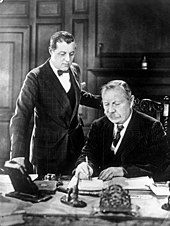
Doyle in 1930, the twelvemonth of his death, with his son Adrian
Doyle was found clutching his chest in the hall of Windlesham Manor, his house in Crowborough, Sussex, on 7 July 1930. He died of a middle assault at the age of 71. His last words were directed toward his wife: "Y'all are wonderful."[117] At the fourth dimension of his expiry, in that location was some controversy concerning his burying identify, as he was avowedly not a Christian, because himself a Spiritualist. He was first buried on xi July 1930 in Windlesham rose garden.
He was later reinterred together with his wife in Minstead churchyard in the New Forest, Hampshire.[ix] Carved wooden tablets to his memory and to the memory of his wife, originally from the church at Minstead, are on display as function of a Sherlock Holmes exhibition at Portsmouth Museum.[118] [119] The epitaph on his gravestone in the churchyard reads, in part: "Steel true/Blade directly/Arthur Conan Doyle/Knight/Patriot, Physician and man of messages".[120]
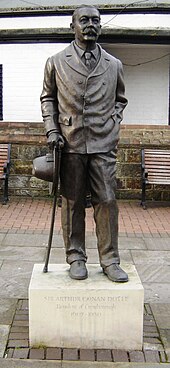
A statue honours Doyle at Crowborough Cross in Crowborough, where he lived for 23 years.[121] There is a statue of Sherlock Holmes in Picardy Place, Edinburgh, close to the house where Doyle was born.[122]
Portrayals [edit]
Arthur Conan Doyle has been portrayed by many actors, including:
Television series [edit]
- Nigel Davenport in the BBC 2 series The Edwardians, in the episode "Conan Doyle" (1972)[123]
- Michael Ensign in the Voyagers! episode "Jack'due south Back" (1983)
- Robin Laing and Charles Edwards in Murder Rooms: Mysteries of the Existent Sherlock Holmes (2000–2001)
- Geraint Wyn Davies in Murdoch Mysteries, 3 episodes (2008–2013)
- Alfred Molina in the Drunkard History (American series) episode "Detroit" (2013)
- David Calder in the miniseries Houdini (2014)
- Martin Clunes in the miniseries Arthur & George (2015)
- Bruce Mackinnon and Bradley Walsh in Drunk History (British series), in serial 2, episodes v and 8 respectively (2016)[124] [125]
- Stephen Mangan in Houdini & Doyle (2016)
- Michael Pitthan in the German TV series Charité episode "Götterdämmerung" (2017)
- Bill Paterson in the Urban Myths episode "Agatha Christie" (2018)
Tv set films [edit]
- Peter Cushing in The Great Houdini (1976)
- David Warner in Houdini (1998)
- Michael McElhatton in Agatha and the Truth of Murder (2018)
Theatrical films [edit]
- Paul Bildt in The Man Who Was Sherlock Holmes (1937)
- Peter O'Toole in FairyTale: A True Story (1997)
- Edward Hardwicke in Photographing Fairies (1997)
- Tom Fisher in Shanghai Knights (2003)
- Ian Hart in Finding Neverland (2004)
Other media [edit]
- Carleton Hobbs in the BBC radio drama Conan Doyle Investigates (1972)[126]
- Iain Cuthbertson in the BBC radio drama Conan Doyle and The Edalji Case (1987)[127]
- Peter Jeffrey in the BBC radio drama Conan Doyle'south Strangest Instance (1995)[128]
- Adrian Lukis in the stage accommodation of the novel Arthur & George (2010)[129]
- Chris Tallman in Affiliate 10 of The Expressionless Authors Podcast (2012)[130]
- Steven Miller in the Jago & Litefoot sound drama "The Monstrous Menagerie" (2014)[131]
- Eamon Stocks in the video game Assassin's Creed Syndicate (2015)[132]
In fiction [edit]
Arthur Conan Doyle is the ostensible narrator of Ian Madden'southward brusk story "Cracks in an Edifice of Sheer Reason".[133]
Sir Arthur Conan Doyle features as a recurring character in Pip Murphy's Christie and Agatha's Detective Agency series, including A Discovery Disappears [134] and Of Mountains and Motors.[135]
See besides [edit]
- William Gillette, a personal friend who performed the most famous stage version of Sherlock Holmes
- List of notable Freemasons
- Physician author
References [edit]
- ^ Stashower says that the compound version of his surname originated from his great-uncle Michael Conan, a distinguished journalist, from whom Arthur and his elder sister, Annette, received the chemical compound surname of "Conan Doyle" (Stashower 20–21). The aforementioned source points out that in 1885 he was describing himself on the contumely nameplate outside his house, and on his doctoral thesis, as "A. Conan Doyle" (Stashower 70).
- ^ Redmond, Christopher (2009). Sherlock Holmes Handbook 2nd ed. Dundurn. p. 97. Google Books. Retrieved 11 February 2017.
- ^ Doyle, Steven; Crowder, David A. (2010). Sherlock Holmes for Dummies. Hoboken, New Bailiwick of jersey: John Wiley & Sons. p. 51.
- ^ a b "No. 27494". The London Gazette. xi Nov 1902. p. 7165.
The entry, 'Arthur Conan Doyle, Esq., K.D., D.L.', is alphabetised based on 'Doyle'.
- ^ "Scottish Writer Best Known for His Cosmos of the Detective Sherlock Holmes". Encyclopædia Britannica. Archived from the original on 27 May 2009. Retrieved 30 Dec 2009.
- ^ "Sir Arthur Conan Doyle Biography". sherlockholmesonline.org. Archived from the original on two February 2011. Retrieved 13 Jan 2011.
- ^ The details of the births of Arthur and his siblings are unclear. Some sources say there were nine children, some say ten. Information technology seems three died in babyhood. See Owen Dudley Edwards, "Doyle, Sir Arthur Ignatius Conan (1859–1930)", Oxford Dictionary of National Biography, Oxford Academy Press, 2004; Encyclopædia Britannica Archived 27 May 2009 at the Wayback Machine; Arthur Conan Doyle: A Life in Messages, Wordsworth Editions, 2007 p. eight; ISBN 978-i-84022-570-ix.
- ^ "Liberton Bank House, one, Gilmerton Road, Edinburgh". Register for Scotland: Buildings at Gamble . Retrieved 28 Apr 2020.
- ^ a b c d due east f g h i j k Owen Dudley Edwards, "Doyle, Sir Arthur Ignatius Conan (1859–1930)", Oxford Dictionary of National Biography, Oxford University Printing, 2004.
- ^ Lellenberg, Jon; Stashower, Daniel; Foley, Charles (2007). Arthur Conan Doyle: A Life in Letters. HarperPress. pp. 8–9. ISBN978-0-00-724759-2.
- ^ Stashower, pp. 20–21.
- ^ Jon Lellenberg; Daniel Stashower; Charles Foley, eds. (2008). Arthur Conan Doyle: A Life in Letters. HarperCollins. ISBN978-0-00-724760-8.
- ^ a b Pascal, Janet (2000). Arthur Conan Doyle: Beyond Baker Street. New York: Oxford University Printing. p. fourteen. ISBN0-nineteen-512262-3.
- ^ a b O'Brien, James (2013). The Scientific Sherlock Holmes: Corking the Case with Scientific discipline and Forensics. New York: Oxford Academy Printing. p. 1. ISBN978-0-xix-979496-6.
- ^ Miller, Russell (2010). The Adventures of Arthur Conan Doyle. New York: Random House. ISBN978-1-4070-9308-6.
- ^ Golgotha Press (2011). The Life and Times of Arthur Conan Doyle. BookCaps Study Guides. ISBN978-1-62107-027-6.
In fourth dimension, he would turn down the Catholic religion and get an agnostic.
- ^ Pascal, Janet B. (2000). Arthur Conan Doyle: Across Baker Street. Oxford University Press. p. 139.
- ^ Brownish, Yoland (1988). Ruyton Eleven Towns, Unusual Name, Unusual History. Brewin Books. pp. 92–93. ISBN0-947731-41-5.
- ^ McNeill, Colin (6 Jan 2016). "Mystery solved of how Sherlock Holmes knew so much near poisonous plants". Herald Scotland. Archived from the original on 26 January 2016. Retrieved 9 January 2016.
- ^ Stashower, Daniel (2000). Teller of Tales: The Life of Arthur Conan Doyle. Penguin Books. pp. 30–31. ISBN0-8050-5074-four.
- ^ Doyle, Arthur Conan (20 September 1879). "Arthur Conan Doyle takes it to the limit (1879)". BMJ. BMJ Publishing Group Ltd. 339: b2861. doi:10.1136/bmj.b2861. S2CID 220100995. Archived from the original on 4 Feb 2014. Retrieved 2 February 2014. (subscription required)
- ^ Doyle, Arthur Conan (twenty September 1879). "Letters, Notes, and Answers to Correspondents". British Medical Journal. BMJ Publishing Group Ltd. (subscription required)
- ^ Robert Mendick (23 May 2015). "Russian supergrass 'poisoned subsequently being tricked into visiting Paris'". The Sun Telegraph. Archived from the original on 24 May 2015.
- ^ Conan Doyle, Arthur (Author), Lellenberg, Jon (Editor), Stashower, Daniel (Editor) (2012). Unsafe Piece of work: Diary of an Arctic Hazard. University of Chicago Press; ISBN 0-226-00905-X, 978-0-226-00905-6.
- ^ Capelotti, P.J. (2013). Shipwreck at Greatcoat Flora: The Expeditions of Benjamin Leigh Smith, England'due south Forgotten Chill Explorer. New York: University of Calgary. pp. 156–162. ISBN978-ane-55238-712-2.
- ^ Bachelor at the Edinburgh Research Archive Archived eleven November 2007 at the Wayback Automobile.
- ^ Stashower, pp. 52–59.
- ^ United Kingdom Gross Domestic Production deflator figures follow the Measuring Worth "consistent series" supplied in Thomas, Ryland; Williamson, Samuel H. (2018). "What Was the U.K. GDP Then?". MeasuringWorth . Retrieved 2 Feb 2020.
- ^ Stashower, pp. 55, 58–59.
- ^ "Compulsory Vaccination – The Evening Mail – The Arthur Conan Doyle Encyclopedia". www.arthur-conan-doyle.com.
- ^ "Compulsory Vaccination – The Hampshire Canton Times – The Arthur Conan Doyle Encyclopedia". www.arthur-conan-doyle.com.
- ^ Higham, Charles (1976). The Adventures of Conan Doyle. New York: Westward.W. Norton. pp. 86–87.
- ^ Diniejko, Andrzej. "Sir Arthur Conan Doyle: A Biographical Introduction". The Victorian Web . Retrieved 21 October 2016.
- ^ Stashower, pp. 114–118.
- ^ Independent, 7 August 2006 Archived 22 February 2011 at the Wayback Automobile;
- ^ Doyle, Arthur Conan, Memories and Adventures (Reprint), Cambridge University Press, (Cambridge) 2012, p. 26.
- ^ Letter from R L Stevenson to Doyle 5 April 1893 The Messages of Robert Louis Stevenson Volume 2/Chapter XII.
- ^ Sova, Dawn B. Edgar Allan Poe: A to Z. New York: Checkmark Books, 2001. pp. 162–163. ISBN 0-8160-4161-X.
- ^ a b c d Carr, John Dickson (1947). The Life of Sir Arthur Conan Doyle.
- ^ City of Westminster green plaques Archived sixteen July 2012 at the Wayback Machine; accessed 22 March 2014.
- ^ Panek, LeRoy Lad (1987). An Introduction to the Detective Story. Bowling Light-green, OH: Bowling Dark-green Country Academy Popular Printing. p. 78. ISBN0-87972-377-7.
- ^ Saunders, Emma (six June 2011). "First Conan Doyle novel to be published". BBC. Archived from the original on 7 June 2011.
- ^ a b Macdonald Hastings, Mary Celeste, (1971); ISBN 0-7181-1024-2.
- ^ "Mary Celeste – definition of Mary Celeste in English from the Oxford dictionary". Archived from the original on 19 Nov 2015. Retrieved nineteen November 2015.
- ^ "Jane Annie – J. G. Barrie and Doyle's Libretto Rather Puzzles London", The New York Times, 28 May 1893, p. thirteen.
- ^ Juson, Dave; Balderdash, David (2001). Total-Time at The Dell. Hagiology Publishing. p. 21. ISBN0-9534474-2-1.
- ^ "Arthur Conan Doyle". ESPN Cricinfo. Archived from the original on 18 Jan 2018. Retrieved 17 Jan 2018.
- ^ "What is the connection between Peter Pan, Sherlock Holmes, Winnie the Pooh and the noble sport of cricket? Archived half dozen March 2012 at the Wayback Car. BBC. Retrieved 25 Nov 2014.
- ^ Parkinson, Justin (26 July 2014). "Authors and actors revive cricket rivalry". BBC News Mag. Archived from the original on 11 April 2019. Retrieved 10 April 2019.
- ^ "London County v Marylebone Cricket Lodge at Crystal Palace Park, 23–25 Aug 1900". Static.cricinfo.com. Archived from the original on 21 July 2011. Retrieved 2 March 2010.
- ^ "Eugen Sandow: Bodybuilding's Keen Pioneer". 25 March 2010. Archived from the original on 25 March 2010. Retrieved 17 November 2020.
- ^ a b Rawson, Mitchell (13 March 1961). "A Instance for Sherlock". Sports Illustrated Vault. Archived from the original on 24 July 2018.
- ^ Arthur Conan Doyle. "Memories and Adventures", p. 222. Oxford University Printing, 2012; ISBN 1441719288.
- ^ "Billiards: The Amateur Title". The Manchester Guardian. 22 Jan 1913. p. viii – via ProQuest Historical Newspapers: The Guardian and The Observer. Retrieved 20 September 2019.
- ^ "An Alpine Pass on 'Ski'". Retrieved nineteen January 2022.
- ^ "How Arthur'south Secret Obsession Changed the World". five January 2022. Retrieved 19 January 2022.
- ^ a b Leeman, Sue, "Sherlock Holmes fans promise to save Doyle'southward house from developers", Associated Press, 28 July 2006.
- ^ Janet B. Pascal (2000). Arthur Conan Doyle: Beyond Baker Street. p. 95. Oxford University Press; ISBN 0195122623.
- ^ "No. 35171". The London Gazette. 23 May 1941. p. 2977.
- ^ "Obituary: Air Commandant Dame Jean Conan Doyle" Archived 18 October 2017 at the Wayback Machine. The Independent; retrieved 6 November 2012
- ^ Itzkoff, Dave (18 January 2010). "Heirs to Sherlock Holmes Face Web of Ownership Issues". The New York Times. ISSN 0362-4331. Archived from the original on nine March 2018.
- ^ "Who owns Sherlock Holmes?". The Telegraph. Archived from the original on 21 Feb 2018. Retrieved 18 July 2017.
- ^ Miller, Russell. The Adventures of Arthur Conan Doyle. New York: Thomas Dunne Books, 2008. pp. 211–217; ISBN 0-312-37897-i,
- ^ "The Coronation Honours". The Times. No. 36804. London. 26 June 1902. p. 5.
- ^ "No. 27494". The London Gazette. xi Nov 1902. p. 7165.
- ^ "Arthur Conan Doyle: 19 things you didn't know" Archived 1 May 2018 at the Wayback Machine. The Daily Telegraph. Retrieved 25 November 2014
- ^ "No. 27453". The London Gazette. 11 July 1902. p. 4444.
- ^ "No. 27550". The London Gazette. 8 May 1903. p. 2921.
- ^ Spiring, Paul. "B. Fletcher Robinson & The Lost World". Bfronline.biz. Archived from the original on iii October 2011. Retrieved two Oct 2011.
- ^ Wijesinha, Rajiva (2013). Twentieth Century Classics: Reflections on Writers and Their Times. Cambridge University Press.
- ^ Winder, Robert (2004). Bloody Foreigners. London: Little, Brown. p. 264. ISBN978-0-349-13880-0.
- ^ International Commentary on Evidence, Volume 4, Issue 2 2006 Commodity 3, Boxes in Boxes: Julian Bardes, Conan Doyle, Sherlock Holmes and the Edalji Instance, D. Michael Risinger
- ^ International Commentary on Testify, Book 4, Effect 2 2006 Article 3, Boxes in Boxes: Julian Barnes, Conan Doyle, Sherlock Holmes and the Edalji Case, D. Michael Risinger
- ^ Roughead, William (1941). "Oscar Slater". In Hodge, Harry (ed.). Famous Trials. Vol. ane. Penguin Books. p. 108.
- ^ Wingett, Matt (2016). Conan Doyle and the Mysterious World of Low-cal, 1887–1920. Life Is Amazing. pp. nineteen–32. ISBN978-0-9572413-5-0.
- ^ Beresiner, Yasha (2007). "Arthur Conan Doyle, Spiritualist and Freemason". Masonic papers. Pietre-Stones Review of Freemasonry. Archived from the original on 9 March 2015.
- ^ a b Wingett, Matt (2016). Conan Doyle and the Mysterious Globe of Light, 1887–1920. Life Is Amazing. pp. 32–36. ISBN978-0-9572413-5-0.
- ^ John Booth. (1986). Psychic Paradoxes. Prometheus Books. p. viii; ISBN 978-0-87975-358-0.
- ^ William Kalush, Larry Ratso Sloman. (2006). The Hole-and-corner Life of Houdini: The Making of America'due south Start Superhero. Atria Books. ISBN 978-0-7432-7208-7.
- ^ Wingett, Matt (2016). Conan Doyle and the Mysterious World of Lite, 1887–1920. Life Is Amazing. pp. 43–44. ISBN978-0-9572413-v-0.
- ^ a b Wingett, Matt (2016). Conan Doyle and the Mysterious World of Light, 1887–1920. Life Is Astonishing. pp. 44–48. ISBN978-0-9572413-v-0.
- ^ Cost, Leslie (2010). "Did Conan Doyle Go Too Far?". Psychic News (4037).
- ^ Ian Topham (31 October 2010). "The Ghost Club – A History past Peter Underwood". Mysteriousbritain.co.britain. Archived from the original on iii July 2013.
- ^ Bakery, Robert A. (1996). Hidden Memories: Voices and Visions from Inside. Prometheus Books. p. 234. ISBN 978-ane-57392-094-0.
- ^ Christopher, Milbourne. (1996). The Illustrated History of Magic. Greenwood Publishing Group. p. 264. ISBN 978-0-435-07016-8.
- ^ Wingett, Matt (2016). Conan Doyle and the Mysterious World of Light, 1887–1920. Life Is Amazing. pp. 160–161. ISBN978-0-9572413-5-0.
- ^ Joseph McCabe. (1920). Is Spiritualism Based On Fraud? The Evidence Given By Sir A. C. Doyle and Others Drastically Examined. Archived 3 December 2013 at the Wayback Machine. London Watts & Co.
- ^ Dearden, Harold. (1975 edition). Devilish Simply True: The Physician Looks at Spiritualism. EP Publishing Limited. pp. 70–72. ISBN 0-7158-1041-3.
- ^ "The Coming of the Fairies". British Library catalogue. British Library. Retrieved 12 June 2013.
- ^ Polidoro, Massimo (July 2006). "Houdini'south Impossible Demonstration". Skeptical Inquirer. The Committee for Skeptical Inquiry. Archived from the original on 12 April 2017. Retrieved vii July 2020.
- ^ Massimo Polidoro. (2003). Secrets of the Psychics: Investigating Paranormal Claims. Prometheus Books. pp. 120–124. ISBN 1-59102-086-7.
- ^ Massimo Polidoro (2011). "Photos of Ghosts: The Burden of Believing the Unbelievable by Massimo Polidoro". Csicop.org. Archived from the original on 2 Dec 2013.
- ^ William Kalush, Larry Ratso Sloman. (2006). The Secret Life of Houdini: The Making of America's Get-go Superhero. Atria Books. pp. 419–420. ISBN 978-0-7432-7208-7.
- ^ Massimo Polidoro. (2001). Terminal Séance: The Strange Friendship Between Houdini and Conan Doyle. Prometheus Books. p. 67. ISBN 978-one-57392-896-0.
- ^ One thousand. K. Nelson. (2013). Spiritualism and Guild. Routledge. p. 159; ISBN 978-0-415-71462-iv.
- ^ Hall, Trevor H. (1978). Sherlock Holmes and his Creator. Duckworth. p. 121.
- ^ Stashower, Daniel (1999). Teller of Tales: The Life of Arthur Conan Doyle. Henry Holt & Company. "A Spiritualist researcher named Leslie Curnow contributed a great bargain of textile and wrote some of the capacity, which Conan Doyle freely admits in the book'south preface."
- ^ Tillyard, Robert John (1926). "The History of Spiritualism". Nature. 118 (2961): 147–149. Bibcode:1926Natur.118..147T. doi:x.1038/118147a0. S2CID 4122097.
- ^ Swinton, A. A. Campbell (1926). "Scientific discipline and Psychical Research". Nature. 118 (2965): 299–300. Bibcode:1926Natur.118..299S. doi:10.1038/118299a0. S2CID 4124050.
- ^ Donkin, Bryan (1926). "Science and Psychical Research". Nature. 118 (2970): 480. Bibcode:1926Natur.118Q.480D. doi:x.1038/118480a0. S2CID 4125188.
- ^ Donkin, Bryan (1926). "Science and Psychical Inquiry". Nature. 118 (2975): 658–659. Bibcode:1926Natur.118..658D. doi:10.1038/118658a0. S2CID 4059745.
- ^ Arthur Conan Doyle Interviewed on Sherlock Holmes and Spirituality. sixteen Apr 2009. Archived from the original on 29 December 2014 – via YouTube.
- ^ "Piltdown Man: U.k.'s Greatest Hoax". BBC. 17 Feb 2011. Archived from the original on 11 July 2013. Retrieved 5 October 2014.
- ^ McKie, Robin (v February 2012). "Piltdown Man: British archaeology's greatest hoax". The Guardian. Archived from the original on viii October 2014. Retrieved 7 February 2022.
- ^ Samuel Rosenberg. (1974). Naked is the Best Disguise: The Expiry and Resurrection of Sherlock Holmes. Bobbs-Merrill. ISBN 0-fourteen-004030-7.
- ^ "Piltdown Man". world wide web.bournemouth.air conditioning.united kingdom . Retrieved 18 November 2019.
- ^ The latter honour did not exist in the lifetime of Dawson, who died in August 1916; the Order of the British Empire was founded on 4 June 1917.
- ^ Knapton, Sarah (10 August 2016). "Sir Arthur Conan Doyle cleared of Piltdown Man hoax". The Telegraph. ISSN 0307-1235. Archived from the original on 11 January 2022.
- ^ Cooke, Simon, 2013, Introduction: Life and Controversy, "Charles Altamont Doyle", The Victorian Spider web.
- ^ Historic England. "Undershaw (1244471)". National Heritage List for England . Retrieved 19 October 2021.
- ^ Duncan, Alistair (2011). An Entirely New Country: Arthur Conan Doyle, Undershaw and the Resurrection of Sherlock Holmes. MX Publishing. ISBN978-1-908218-19-3.
- ^ "Sir Arthur Conan Doyle house development appeal upheld". BBC News. 12 November 2012. Archived from the original on 16 November 2012.
- ^ Griffith, Carolyn. "Campaigner says hotel's writer link should secure landmark building". Lymington Times, 15 September 2017.
- ^ Glasshayes House: the 1912 extension of The Lyndhurst G Hotel. Archived 17 September 2017 at the Wayback Machine, The Arthur Conan Doyle Encyclopedia, 2017.
- ^ The Golfball Factory, accessed September 2017, Sir Arthur Conan Doyle – Golf Form Architect. Archived 17 September 2017 at the Wayback Motorcar.
- ^ Crossley, Frankie (17 August 2017). "Mistiness guitarist leads fight to save Camden Route Spiritualist Temple". Hampstead Highgate Limited.
- ^ Stashower, p. 439.
- ^ Express, Alamy. "Stock Photo – Wooden headstone of Sir Arthur Conan-Doyle at a special display in the Town's museum. Portsmouth, Hampshire, UK". Alamy. Archived from the original on 16 March 2016. Retrieved 15 March 2016.
- ^ "City Museums". www.portsmouthcitymuseums.co.uk. Archived from the original on 21 March 2016. Retrieved 15 March 2016.
- ^ Johnson, Roy (1992). "Studying Fiction: A Guide and Study Programme", p. xv. Manchester University Printing; ISBN 0719033977.
- ^ "Arthur Conan Doyle (1859–1930)". librarything.com. Archived from the original on six October 2014. Retrieved 17 March 2012.
- ^ "Sherlock Holmes statue reinstated in Edinburgh after tram works", bbc.co.uk; retrieved 6 November 2012.
- ^ "The Edwardians: Conan Doyle". BBC Genome: Radio Times. BBC. Retrieved 10 November 2020.
- ^ "Drunk History Series ii, Episode 5". British Comedy Guide . Retrieved ten November 2020.
- ^ "Drunk History Series 2, Episode eight". British Comedy Guide . Retrieved 10 November 2020.
- ^ "Saturday-Nighttime Theatre: Conan Doyle Investigates". BBC Genome: Radio Times. BBC. Retrieved 10 Nov 2020.
- ^ "Saturday-Dark Theatre: Conan Doyle and the Edalji Case". BBC Genome: Radio Times. BBC. Retrieved ten November 2020.
- ^ "Sabbatum Playhouse: Conan Doyle's Strangest Instance". BBC Genome: Radio Times. BBC. Retrieved ten Nov 2020.
- ^ Michael, Billington (23 March 2010). "Arthur and George". The Guardian . Retrieved 10 November 2020.
- ^ "The Dead Authors Podcast : Chapter x: Arthur Conan Doyle, featuring Chris Tallman". thedeadauthorspodcast.libsyn.com . Retrieved 23 September 2021.
- ^ "7. Jago & Litefoot Series 07". Big Finish Productions . Retrieved 10 November 2020.
- ^ "Assassinator'due south Creed: Syndicate Cast". Behind The Voice Actors . Retrieved ten Nov 2020.
- ^ Madden, Ian, "Cracks in an Building of Sheer Reason", in Maguire, Susie, & Tongue, Samuel (eds.) (2018), With Their All-time Clothes On, New Writing Scotland 36, Clan for Scottish Literary Studies, pp. 77–85. ISBN 978-ane-906841-33-one
- ^ Murphy, Pip (2021). A Discovery Disappears. Roberta Tedeschi, ill. Leicester: Sweet Cherry Publishing. ISBN978-1-78226-796-6. OCLC 1263776847.
{{cite book}}: CS1 maint: engagement and year (link) - ^ Murphy, Pip (2022). Of Mountains and Motors. Roberta Tedeschi, ill. Leicester: Sugariness Cerise Publishing. ISBN978-1-78226-815-four. OCLC 1295111029.
{{cite volume}}: CS1 maint: date and year (link)
Farther reading [edit]
- Martin Booth (2000). The Md and the Detective: A Biography of Sir Arthur Conan Doyle. Minotaur Books. ISBN 0-312-24251-four
- John Dickson Carr (2003 edition, originally published in 1949). The Life of Sir Arthur Conan Doyle. Carroll and Graf Publishers.
- Michael Dirda (2014). On Conan Doyle: or, The Whole Fine art of Storytelling. Princeton Academy Press. ISBN 978-0691164120
- Arthur Conan Doyle, Joseph McCabe (1920). Debate on Spiritualism: Between Arthur Conan Doyle and Joseph McCabe. The Appeal'due south Pocket Series.
- Bernard M. L. Ernst, Hereward Carrington (1932). Houdini and Conan Doyle: The Story of a Strange Friendship. Albert and Charles Boni, Inc.
- Margalit Play a trick on (2018). Conan Doyle for the Defense force. Random House.
- Kelvin Jones (1989). Conan Doyle and the Spirits: The Spiritualist Career of Sir Arthur Conan Doyle. Aquarian Printing.
- Jon Lellenberg, Daniel Stashower, Charles Foley (2007). Arthur Conan Doyle: A Life in Messages. HarperPress. ISBN 978-0-00-724759-2
- Andrew Lycett (2008). The Man Who Created Sherlock Holmes: The Life and Times of Sir Arthur Conan Doyle. Gratuitous Press. ISBN 0-7432-7523-3
- Russell Miller (2008). The Adventures of Arthur Conan Doyle: A Biography. Thomas Dunne Books.
- Pierre Nordon (1967). Conan Doyle: A Biography. Holt, Rinehart and Winston.
- Ronald Pearsall (1977). Conan Doyle: A Biographical Solution. Littlehampton Book Services Ltd.
- Massimo Polidoro (2001). Final Séance: The Strange Friendship Betwixt Houdini and Conan Doyle. Prometheus Books. ISBN 978-1-57392-896-0
- Daniel Stashower (2000). Teller of Tales: The Life of Arthur Conan Doyle. Penguin Books. ISBN 0-8050-5074-4
External links [edit]
Digital collections
- Works by Arthur Conan Doyle in eBook grade at Standard Ebooks
- Works by Arthur Conan Doyle at Project Gutenberg
- Works past Arthur Conan Doyle at Faded Page (Canada)
- Works by Arthur Conan Doyle at Project Gutenberg Australia
- Works by or about Arthur Conan Doyle at Net Archive
- Works by Arthur Conan Doyle at LibriVox (public domain audiobooks)

- Poems by Arthur Conan Doyle
Physical collections
- Arthur Conan Doyle Papers, Photographs, and Personal Effects at the Harry Ransom Eye
- Arthur Conan Doyle Drove at Toronto Public Library
- Sir Arthur Conan Doyle Collection at Dartmouth Higher Library
- Arthur Conan Doyle Online Exhibition
- "Archival material relating to Arthur Conan Doyle". UK National Archives.
- C. Frederick Kittle's Drove of Doyleana Archived half dozen Jan 2011 at the Wayback Motorcar at the Newberry Library
- Newspaper clippings about Arthur Conan Doyle in the 20th Century Press Archives of the ZBW

Biographical information
- Doyle, Sir Arthur Conan, Knt. – Cr. 1902, The county families of the United kingdom of great britain and northern ireland or Purple manual of the titled and untitled aristocracy of England, Wales, Scotland and Ireland, (Volume ed. 59, yr. 1919) (page 109 of 415) by Edward Walford
- The Arthur Conan Doyle Encyclopedia
- Conan Doyle in Birmingham
Other references
- 1930 audio recording of Conan Doyle speaking
- Arthur Conan Doyle at Curlie
- The short film Arthur Conan Doyle (1927) (Play a joke on newsreel interview) is available for complimentary download at the Internet Archive.
- The Arthur Conan Doyle Society
- Arthur Conan Doyle quotes
- Arthur Conan Doyle at the Internet Speculative Fiction Database
- Arthur Conan Doyle at IMDb

How To Apply A Wingetts Template For Grandpa,
Source: https://en.wikipedia.org/wiki/Arthur_Conan_Doyle
Posted by: halltheence.blogspot.com
0 Response to "How To Apply A Wingetts Template For Grandpa"
Post a Comment